
Cost Share for a $15K Coolant Unit Under Korea's 2027 Smart Factory Grant
Korea's 2027 smart factory program (government-general type) covers 50 to 70% of sensors and automation equipment. On a 20 million won coolant management unit, the plant pays 6 to 10 million won. Plants under 10 employees should compare a second program.
Quotes for a coolant sterilizer or filtration unit often land at around 20 million won per unit in the total line. Before anyone counts the concentrate saved by longer fluid life, the question is where this year's budget will absorb that figure. This article works out how much of the 20 million won the plant itself pays when government support applies.
The first question is whether the equipment qualifies.
The 2027 Smart Manufacturing Innovation Support Program integrated notice, issued October 30, 2026 by Korea's Ministry of SMEs and Startups, includes a government-general type smart factory track. The government covers part of the cost and the plant pays the rest, as in a standard build-out subsidy.
Support under this track is up to 200 million won per award, with a government share of 50 to 70%. Eligible items include automation equipment, controllers and sensors.
Some coolant management equipment measures tank concentration and contamination, then tops up concentrate automatically when concentration drops. It collects sensor data and controls automatically, so it can be described under this item.
Individual notices will come out in sequence from November 2026. Applications close in January 2027.
With that settled, the plant's actual payment on one 20 million won unit can be calculated.
The formula is plant share = equipment cost x (1 - government share). Assume one unit at 20 million won.
If the government share is set at 50%, the plant pays 20 million won x (1 - 0.5) = 10 million won. At 70%, it pays 20 million won x (1 - 0.7) = 6 million won. The same machine differs by 4 million won depending on the rate.
With several units, as long as total government support stays within the 200 million won cap per award, multiply by the unit count in the same formula.
For the equipment cost, use the total on the quote rather than the base unit price. Installation and piping work may be billed separately.
The actual rate between 50% and 70% is set in the individual notice. Budget at 50%, and if the rate comes out higher, you spend less.
Plants with fewer than 10 employees have one more program to compare.
The Small Manufacturer Clean Manufacturing Environment program, run by the Ministry of SMEs and Startups and the Korea Federation of Micro Enterprise Promotion agency (Semas), targets manufacturers with fewer than 10 regular employees. Supported items are safety device replacement and repair, smart safety equipment, and industrial waste handling.
National funding is up to 70%, but there are amount caps. For businesses classed as high-risk, such as auto parts manufacturing or metal products for construction, the cap is 10.5 million won.
For a 20 million won unit, the plant receives the 10.5 million won cap rather than 70%, or 14 million won, so its share is 20 million won - 10.5 million won = 9.5 million won.
For other industries the cap is 6.3 million won, which raises the plant's share on the same unit to 13.7 million won. Whether spent coolant equipment falls under the industrial waste handling item is something to check in the detailed criteria of the next call for applications.
For a high-risk plant, the 9.5 million won under this program is nearly the same as the 10 million won at a 50% smart factory rate. The third call of 2026 for this program closed on October 20.
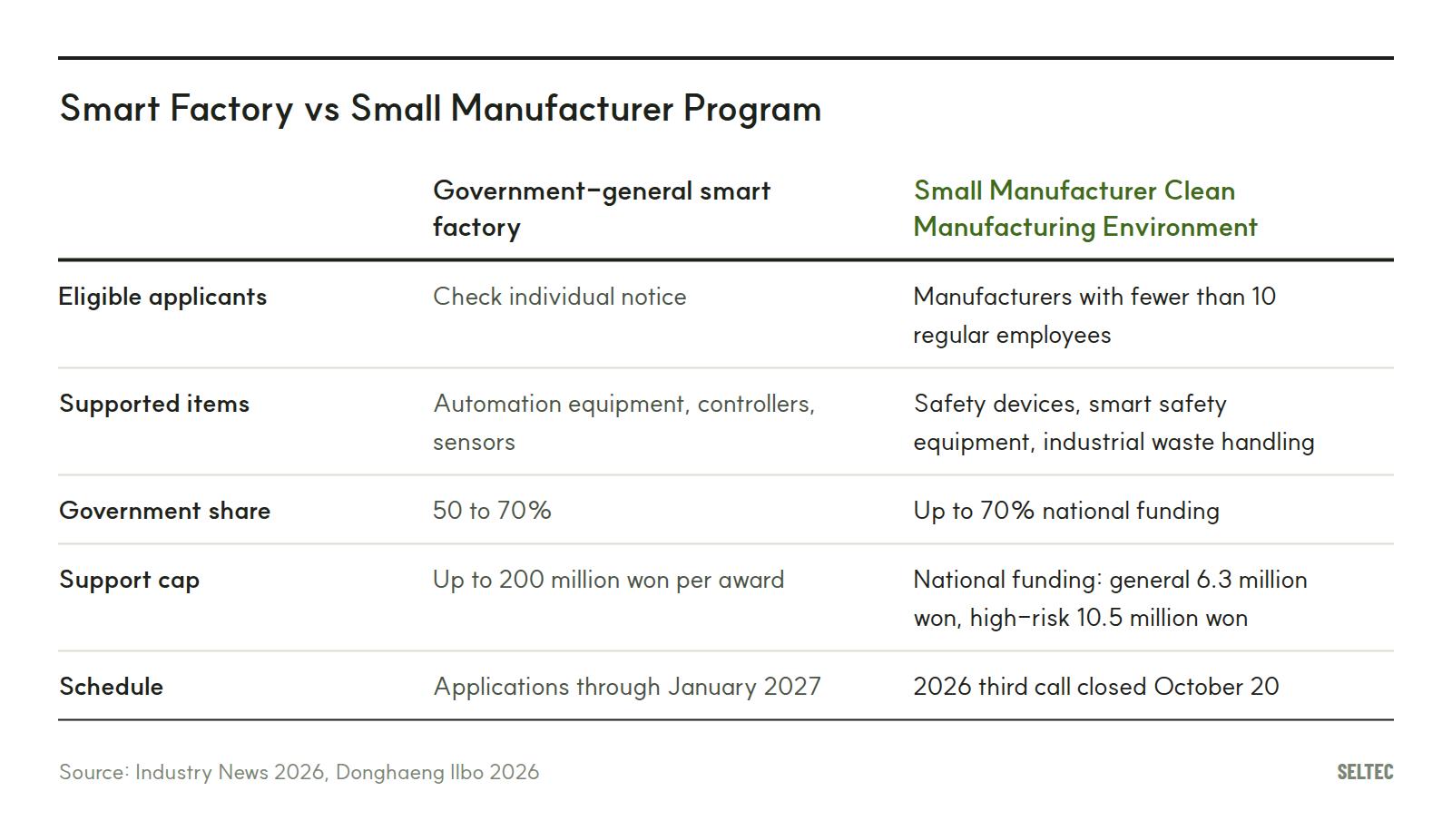
Whichever program you choose, the application needs current conditions and targets in numbers, so record concentrate purchases, tank changes and spent coolant volume by month before applications close in January 2027. A single tank change bundles concentrate cost, spent coolant collection and disposal, tank cleaning and lost production time.
One question remains: purification equipment. Whether a unit that only purifies, with no concentration sensor or automatic top-up, can qualify as a smart factory project may vary by notice. The eligibility wording in the notices due from November should answer it.
- Government share, government-general smart factory
- 50 to 70%
- Support cap, government-general smart factory
- Up to 200 million won per award
- 2027 integrated notice application period
- Through January 2027
- Clean manufacturing program national funding cap
- General 6.3 million won, high-risk industries 10.5 million won
- Plant share on a 20 million won unit (smart factory)
- 6 to 10 million won
Frequently asked questions
Can a coolant purification unit alone apply for the smart factory program?
Eligible items under the government-general type are automation equipment, controllers and sensors. A purification-only unit is better described together with functions that measure concentration and contamination and top up automatically. Eligibility is set in the eligible-items wording of the individual notices issued from November 2026.
Can concentrate purchases or spent coolant disposal costs get government support?
The smart factory program supports equipment such as automation equipment, controllers and sensors. A manufacturer with fewer than 10 regular employees should check the detailed criteria of the next call for the Small Manufacturer Clean Manufacturing Environment program, to see how far its industrial waste handling item reaches for spent coolant.
What is the deadline for the 2027 Smart Manufacturing Innovation Support Program?
The integrated notice came out on October 30, 2026, and individual notices follow in sequence from November 2026. Applications close in January 2027, and exact deadlines are set in the individual notices.
Which program fits a plant with fewer than 10 employees?
The Small Manufacturer Clean Manufacturing Environment program caps national funding at 6.3 million won in general and 10.5 million won for high-risk industries, so it suits equipment with a total project cost of roughly 9 to 15 million won or less. If you bundle several 20-million-won-class units, the plant share can come out lower under the government-general smart factory track, where the government pays 50 to 70%.
Industry News: 2027 Smart Manufacturing Innovation Support Program integrated notice
Donghaeng Ilbo: Third call for the Small Manufacturer Clean Manufacturing Environment program
Kyeongnam Shinmun: Water-soluble coolant series part 4, management equipment and support needs
Kyeongnam Shinmun: Water-soluble coolant series finale, alternatives and field trials