
Coolant Management Automation: Downtime and Concentrate Cost
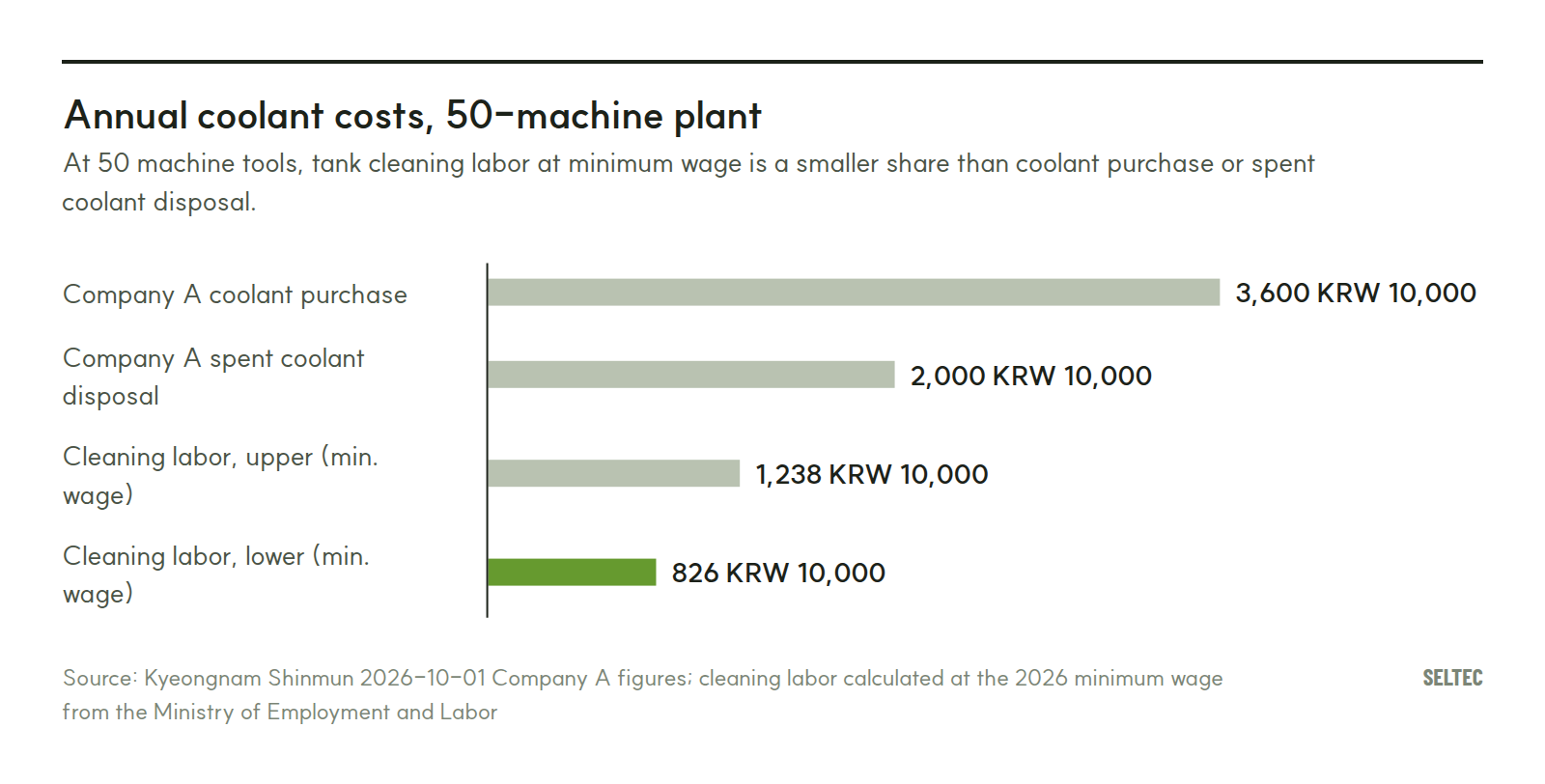
For a 50-machine plant, tank cleaning labor at minimum wage is about KRW 8.26 to 12.38 million a year, less than coolant purchase or disposal. In 2026, downtime and concentration errors that waste concentrate and tooling decide the payback.
Automation reviews usually start with a person. One operator checks concentration and tops up concentrate, and the question is how many years of that wage it takes to pay off the equipment. Plug in the published numbers one by one and the labor figure comes out smaller than expected. What stands against the equipment price is idle machines, discarded concentrate and worn-out tools.
Tank cleaning time for 50 machine tools
According to Kyeongnam Shinmun (October 1, 2026), cleaning one mid-size machine tool tank takes about 8 hours for one person. Water-soluble coolant is usually changed every 3 to 6 months, or 2 to 3 times a year. If each of 50 machine tools has one mid-size tank, cleaning alone takes 800 to 1,200 person-hours a year. Multiply by the 2026 minimum wage of KRW 10,320 per hour, set by Korea's Ministry of Employment and Labor, and you get roughly KRW 8.26 million to 12.38 million.
That is a floor. Few plants hand tank cleaning to minimum-wage staff. Scooping out sludge, flushing the piping and mixing fresh coolant take someone who knows the equipment, and that person's hourly cost carries insurance, bonuses and overtime.
Some items are missing too. No public figure exists for the time spent each day measuring concentration and mixing concentrate with water for top-ups. Even a few minutes per machine, multiplied by machine count and working days, adds up to something comparable to the cleaning hours. Practices differ from plant to plant, so no value is set here. Pull it from your own work logs and add it to the cleaning time separately.
Downtime outweighs labor
During those 8 hours the machine cuts no parts. When orders are thin, that hurts little. The second half of 2026 is different.
Industry Daily (September 12, 2026) reported on a Hana Securities report. According to KOMMA figures, domestic machine tool orders in July were KRW 368.7 billion, up 79% from a year earlier, and January to July orders totaled KRW 2.24 trillion, up 23%. The report assumes orders take about 6 months to become revenue and expects better utilization from the second half of 2026 through 2027. That utilization reads as a story about the builders of machine tools. Still, the buyers who run those machines are machining plants, and demand has widened from automotive to defense, aerospace, semiconductors and data centers. If there is enough work to justify new machines, every hour an existing machine sits idle costs more.
When work piles up, tank cleaning slips to weekends or nights, picks up overtime rates, or the cleaning interval stretches. If coolant goes bad in a tank that was put off, the next cleaning takes longer, and odor and skin problems follow.
An estimate from Company A in the Changwon industrial complex shows the structure. With 50 machine tools and KRW 8 billion in sales, it spends about KRW 36 million a year on coolant and about KRW 20 million on spent coolant disposal. Adding labor and lost production, Company A thinks the total passes KRW 100 million a year. Subtract the KRW 56 million for purchase and disposal and at least KRW 44 million is labor and production loss. Subtract the KRW 12.38 million minimum-wage cleaning ceiling and more than KRW 30 million remains. Company A did not split the two, and the KRW 100 million is itself a rough figure. The remaining KRW 30 million also mixes in skilled workers' actual pay and the daily concentration checks. However it is divided, a minimum-wage cleaning figure captures only a corner of the cost Company A feels.
Higher concentrate and tool prices make concentration errors costly
The same Kyeongnam Shinmun article (October 1, 2026) puts concentrate at KRW 1 million to 1.2 million per 200 L drum, and cites a case that rose from the KRW 200,000 range ten years ago to over KRW 1.2 million. According to Kyunghyang Shinmun (April 3, 2026), domestic refiners raised lubricant prices across the board in March and April. SK Enmove raised prices 15 to 30% from April 13, and S-Oil Total Energies Lubricants raised them 18 to 35% in early March. Higher base oil prices and logistics costs from the Strait of Hormuz blockade were cited as causes. The article covered lubricants in general, so how much coolant product prices rose is unconfirmed. Plants in Changwon and Gimhae say carbide cutting tool prices have also risen 30 to 100% over the past year.
Concentration mixed by hand leaks money in both directions. Mix it rich and more concentrate goes in, with foam and skin irritation following. Mix it lean and lubrication and rust protection drop, tools wear faster, and rancidity (bacterial growth) sets in sooner, pulling the change forward. Going by the field figure that buying 1 t of concentrate produces about 2 t of waste, each pulled-forward change also moves disposal cost, about KRW 100,000 per drum. The right concentration follows the concentrate maker's recommended range. The hard part is keeping it inside that range every day.
In a SELTEC CP03 catalog case from a mold machining customer, concentration variation fell from plus or minus 12% to within 2%, and tool life rose 1.6 times. It is the company's summary of one customer's results, so it cannot be carried over to other plants as is. Still, if tool prices really rose 30 to 100% in a year, the tool life line in a payback calculation now carries that much more weight.
What to automate and what stays with people
Mixing and top-ups happen every day, repeated for every machine. Concentration and contamination checks come around daily or every shift. Tank purification and cleaning happen only 2 to 3 times a year, but each takes about 8 hours. Handing the most frequent jobs to a machine makes the math work fastest. Mixing and top-ups depend on each person's touch, and they are the first thing skipped when things get busy. The concentration errors described above start here. An automatic coolant mixing and supply system, which dilutes concentrate at a set ratio and corrects concentration automatically, takes over exactly this repetitive work.
Measurement is moving to sensors. Kyeongnam Shinmun (October 13, 2026) described a management method that measures concentration and contamination in real time and builds up data to predict the change point. If you set the change by condition instead of by date, there is room to stretch the 2 to 3 times a year interval itself.
Cleaning is rare, but it takes a machine down for a long stretch. FITCLEAN102 removes chips and purifies the coolant at the same time and feeds it back, so the tank is cleaned without stopping the machine tool. What shrinks with this method is mainly downtime, more than cleaning labor.
When a sensor reading jumps, finding the cause, spotting which machine is leaking tramp oil, and making the final call on when to change coolant are still jobs for someone who knows the equipment. Math that automates people away is usually wrong. Math where the same person watches more machines is closer to reality.
According to the October 13 Kyeongnam Shinmun article, sterilization and filtration units cost in the KRW 20 million range each and also need specialist staff. Compare that figure only with the KRW 8.26 million to 12.38 million in cleaning labor and payback looks long. The comparison should be the sum of cleaning time, machining loss while the machine sits idle, and concentrate and tooling wasted through concentration errors. At a scale like Company A, with KRW 56 million in purchase and disposal alone, even a slightly longer change interval shifts that sum a lot.
How to run the numbers for plants under 50 employees
According to Kyeongnam Shinmun (October 7, 2026), water quality rules for the lower Nakdong River require 179 water-soluble coolant users in Gimhae to relocate to an industrial complex by December 31, 2028. Many have fewer than 50 employees. Korea's Ministry of Environment amended its 2020 notice to allow existing facilities that meet environmental management conditions to move into industrial complexes, and set the deadline as part of that change.
Gimhae City, the Gimhae Chamber of Commerce and the Korea Federation of SMEs asked the government to recognize an exception for plants that outsource all their wastewater treatment, to allow small closed-loop integrated units, and to extend the deadline. In June 2026 the Minister of Environment toured the site. The October 13 series noted the need for shared sterilization and filtration facilities in the complex, with specialist staff managing several companies, and carried calls for equipment support from local governments and the Korea SMEs and Startups Agency. Whether the requests will be accepted, and what a shared facility would look like, is not yet decided.
The math is different where there are only a few machines. Buying KRW 20 million units on your own stretches payback no matter how much cleaning time and concentrate you save. A relocation means laying new tanks, piping and supply lines anyway. For plants under 50 employees, the right calculation is to decide at the relocation design stage which parts will connect to the shared facility and which will be fitted to each machine tool.
- Cleaning time for one mid-size machine tool tank
- About 8 hours per person (Kyeongnam Shinmun, 2026-10-01)
- Water-soluble coolant change interval
- Every 3 to 6 months, 2 to 3 times a year (Kyeongnam Shinmun, 2026-10-01)
- Cleaning labor for a 50-machine plant (minimum wage basis)
- About KRW 8.26 million to 12.38 million (calculated at the 2026 minimum wage of KRW 10,320)
- Company A (Changwon industrial complex) annual coolant purch
- About KRW 36 million and about KRW 20 million (Kyeongnam Shinmun, 2026-10-01)
- Korean machine tool orders, July 2026
- KRW 368.7 billion, up 79% year on year (KOMMA, Industry Daily 2026-09-12)
- Water-soluble coolant users required to relocate from Gimhae
- 179 companies, deadline December 31, 2028 (Kyeongnam Shinmun, 2026-10-07)
Frequently asked questions
How much does tank cleaning labor cost per year at a 50-machine plant?
Assuming one tank per machine, about 8 hours for one person per mid-size tank and 2 to 3 changes a year, the total is 800 to 1,200 person-hours. At the 2026 minimum wage of KRW 10,320, that is roughly KRW 8.26 million to 12.38 million. Skilled labor pay and the daily time spent measuring and topping up concentration push the real figure higher.
What should a KRW 20 million class management unit be compared against to calculate payback?
Against cleaning labor alone, payback looks long. Compare it with cleaning time, the machining loss while machines sit idle, and the concentrate and tooling wasted through concentration errors. Company A in the Changwon industrial complex estimated that purchase and disposal plus labor and lost production exceed KRW 100 million a year.
Which costs does automatic concentration control reduce as concentrate prices rise?
A rich mix uses more concentrate. A lean mix wears tools faster and brings on rancidity, which pulls coolant changes forward and adds disposal cost. Plants report concentrate at KRW 1 million to 1.2 million per drum and carbide tool prices up 30 to 100% in a year, so keeping concentration in range is worth more.
Does automation make sense for plants under 50 employees with only a few machines?
Buying KRW 20 million class units on your own stretches payback. Where a move to an industrial complex is coming, as in Gimhae, it is more realistic to decide at the relocation design stage which parts connect to shared sterilization and filtration and which equipment goes on each machine tool.
Kyeongnam Shinmun: Long-life coolant management methods and the equipment burden on small companies
Kyunghyang Shinmun: Korean refiners raise lubricant prices by up to 35%
Korea Policy Briefing (Ministry of Employment and Labor): 2026 minimum wage of KRW 10,320 per hour
Industry Daily: Korean and Japanese machine tool orders rise, utilization outlook through 2027