
Coolant Tank Sludge and Fine Chips: Filtering and Cleaning
Clogged filters and nozzles and the Monday-morning tank smell often start with fine chips that drift in the tank and settle on the bottom. Match magnets, filters and cyclones to the chip material, and set the cleaning interval from bottom-check records.
Some tanks get the concentration right and take a biocide dose, yet the same smell and the same clogging come back within weeks. Check the bottom of those tanks first.
Fine chips and sludge are not something to clean only when you find a free day. This is a process to fix before concentration control and rancidity (bacterial growth) control.
The problem is fine chips, not the chips you can see
The large chips that the chip conveyor carries away rarely cause big trouble. The trouble comes from fine chips that slip through gaps in the conveyor chain and the mesh of the basket.
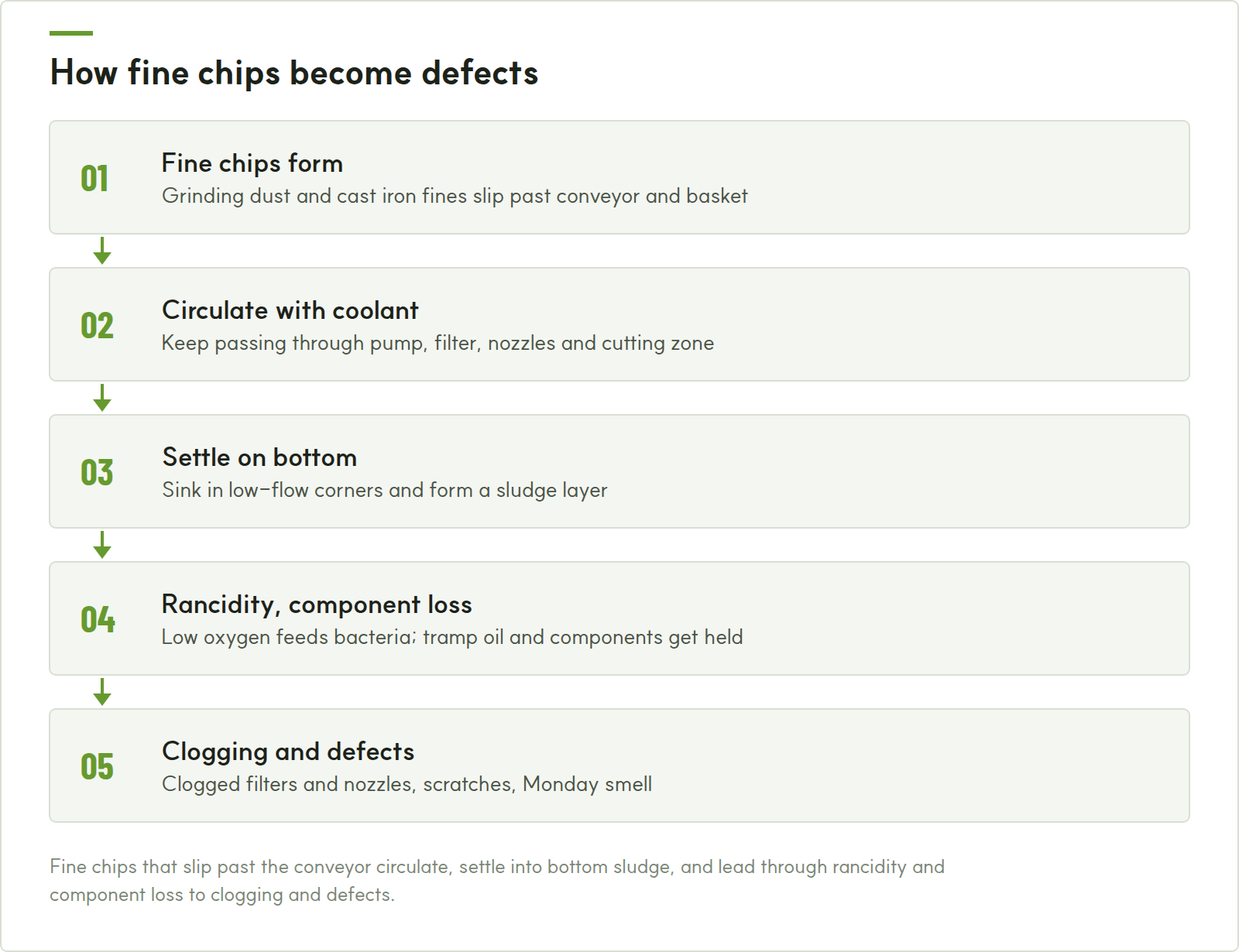
Grinding dust and cast iron fines are as fine as flour. They mix into the coolant, circulate through the tank, get drawn back into the pump, and pass in turn through the filter, the nozzles and the cutting zone. If you fit a new filter and discharge flow weakens within three days, or operators poke the nozzle tips clear with a pick every morning, assume these fine chips are circulating.
When a nozzle is half blocked, coolant does not reach the tool tip properly. Circulating fine chips get caught between the tool and the work surface and leave fine scratches. Pump impellers and seals wear quickly because they are effectively moving water laced with abrasive.
If filters and nozzles clog often, find out how many fine chips are circulating before you change the filter grade.
Why bottom sludge ruins coolant so fast
Bottom sludge breeds bacteria where circulation doesn't reach, and it consumes coolant components.
When fine chips settle in tank corners, behind baffles and in low-flow spots, they form a layer like mud. Little oxygen reaches the inside of this layer, so anaerobic bacteria grow easily. When circulation stops over the weekend, gas formed at the bottom rises, and the rotten smell you get when you open the tank lid on Monday morning usually comes from here. If you dose biocide only at the surface, the bottom layer remains and the bacteria spread again.
Fine chips have a large surface area for their weight. They can hold tramp oil and adsorb emulsifiers and rust inhibitors onto their surfaces, using them up. The result is a refractometer reading that looks normal while rust protection and lubricity have dropped. Tramp oil in the mix can also make a refractometer read higher than the actual concentration.
Follow your coolant manufacturer's recommended ranges for concentration and pH. For the causes of odor and what to do about them, see our coolant odor article. For how to read concentration with a refractometer, see our coolant concentration article.
Five checks of your tank's condition
You can do these five checks today with no special equipment. Only check 1, the settling test, needs a second look the next day.
- Take a coolant sample in a clear bottle and leave it for a day. Draw it at the pump discharge or at mid-depth in the tank. If a gray or black layer of sediment is on the bottom the next day, a lot of fine chips are circulating. If an oil layer floats on top, you also need to deal with tramp oil.
- Push a long rod to the tank bottom and scrape up a sample. If the sludge on the rod is thick and black and smells rotten, clean the bottom before anything else.
- Pull the filter changes and nozzle cleanings for the last three months from your records. If they rise every month, more chips are coming in than your cleaning capacity can handle.
- Identify the chip material. Write down which is mainly coming off: steel, cast iron, aluminum or grinding dust. Holding a magnet to the sediment shows right away whether it is ferrous. Use the result to choose the separation method in the next section.
- Look at the chip basket and the discharged chips. If coolant runs out when you squeeze a handful of chips, or coolant pools at the bottom of the chip bin, review the last section as well.
Choosing a separation method for the chip material and size
Choose the separation method by chip material and particle size. If you try to catch every chip with one method, a gap will open somewhere.
- Magnetic separator: catches steel chips and cast iron fines. It does not work on aluminum, non-ferrous metals or grinding wheel grit.
- Filter: the finer the filter, the better it catches fine particles, but the faster it clogs. Change frequency and consumables cost rise together.
- Settling tank: needs almost no power or consumables. Heavy particles settle, but light fine particles do not all settle within the residence time and carry over. Settling tanks also have to be dug out regularly.
- Cyclone: creates a rotating flow and separates particles by density difference, with no consumables. It separates heavy particles such as metal well, but some very light or fine particles escape.
Plants with a central tank
When several machine tools share one tank, the basic setup removes heavy particles from the return line first. Put a magnet up front for steel, or a cyclone if the materials are mixed, and finish the remaining fine particles with a filter. Taking heavy particles out upstream lengthens the change interval of the same filter.
Plants where each machine tool has its own tank
When each machine has a small tank, it is hard to pipe everything to a central system. Here, attaching one purification unit to each machine tool is the practical approach. SELTEC's CLEANFIT-DS is also a 1:1 unit that connects directly to one machine tool and separates solids with a cyclone. Start with the machine that had the most frequent filter and nozzle cleaning in check 3, and add units one at a time.
Plan tank cleaning so the equipment keeps running
In normal operation, circulation purification slows the rate at which sludge builds up. Put a bottom-cleaning date on the calendar so it doesn't get postponed. Cleaning usually slips because the equipment has to be stopped.
Clean in this order:
- Remove the chips first. Clear floating debris on the surface, the basket, and chips packed under the conveyor. Otherwise hoses and piping clog when you recover the sludge.
- Recover the bottom sludge. Don't miss the corners, the area behind baffles and the area under the pump suction. Store the recovered sludge separately as waste.
- Disinfect. Treat the film on the bottom and walls too. The biocide type and dose can react with coolant components, so check with your coolant manufacturer first.
- Readjust the concentration. Water gets in and concentrate is lost during cleaning, so measure again with a refractometer and top up.
- Record it. Write down the date, the amount of sludge recovered (how many buckets), the odor, the concentration and the pH.
Set the cleaning interval from your own tank's records rather than a fixed number. Repeat the rod check from check 2 every week, find how long it takes for sludge to build back up to a problem level, and schedule cleaning a little ahead of that.
A tank cleaner that removes chips and purifies at the same time while returning coolant to the tank (SELTEC's FITCLEAN102 works this way) lets you clean the bottom without stopping the machine tool. That cuts the cases where cleaning slips because of the production schedule.
Count the coolant that leaves with the chips
In chip-heavy processes, coolant clings to the discharged chips and leaves with them. The more chips, the more concentrate you add, and the chip storage floor stays wet, so operators can slip easily.
Coolant that leaves this way also adds to disposal cost along with the chips. You can compress the chips to recover the coolant on them. To see where spent coolant cost leaks out, see our spent coolant cost article.
This week, pick one chip bin and check whether coolant is pooled on the floor. If it is, record the amount for one week.
- Patent related to FITCLEAN102
- Sterilizing and cleaning machine for water-soluble coolant tanks, KR10-2078341 (registered 2020)
- Patent related to FIT
- Circulating coolant tank purification system, KR10-2131381 (registered 2020)
Frequently asked questions
Will a magnetic separator alone solve the fine chip problem?
A magnetic separator catches only steel chips and cast iron fines. Aluminum, non-ferrous metals and grinding wheel grit keep circulating. Hold a magnet to the sediment to confirm the chip material first, and combine the separator with a cyclone or filter if needed.
Can't I just switch to a finer filter?
A finer filter catches more fine particles but clogs faster, so changes and consumables cost go up. If you remove heavy particles upstream with a magnet or cyclone first, the same filter lasts longer.
How often should I clean the coolant tank bottom?
Set it from your own tank's check records rather than a fixed number. Scrape the bottom with a long rod every week, find how long sludge takes to build back up, and schedule cleaning a little ahead of that. Circulation purification slows the buildup.
Does a cyclone also remove aluminum chips and grinding dust?
A cyclone relies on density difference, so it separates heavy metal particles well, but some light material such as aluminum or very fine grinding dust can escape. Test the separation with a sample of your plant's coolant, and add a filter downstream to finish if needed.